
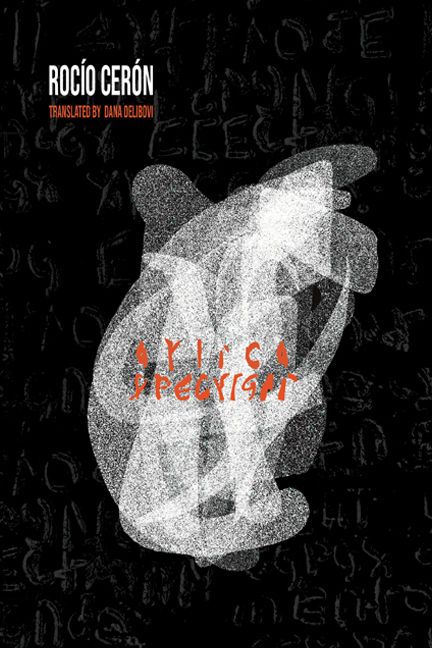
Áurica Speculari
by Rocío Cerón
Translated by Dana Delibovi
"Mexican poet Rocío Cerón stands as one of the most singular voices in contemporary poetry: experimental, deeply lyrical, and a central figure of the post‑avant‑garde. In her work, experimentation is not an ornament but the very architecture of the poem, rupture, syntactic play, and the juxtaposition of multiple discourses shape a poetics in constant transformation.
This formal innovation never excludes a social concern; rather, Cerón approaches the political with a complexity that avoids the easy gesture and resists the pamphleteering mode. Hers is a poetry that thinks, listens, and unsettles.
Translator and poet Dana Delibovi does remarkable work in this volume, capturing the breadth of the verse, its sonic texture, and its conceptual scaffolding, offering an English version that preserves both the intensity and the precision of the original."
—Marta López Luaces, Professor of Spanish and Latino Studies at Montclair State University; poet, fiction writer, translator, and the author of Talar un nogal and Arquitectos de lo imaginario
"La poeta Rocío Cerón es una de las voces más singulares de la poesía mexicana contemporánea: experimental, profundamente lírica y una figura central del posvanguardismo. En su obra, la experimentación no es un gesto superficial, sino la arquitectura misma del poema: rupturas, desplazamientos sintácticos, yuxtaposición de registros y un diálogo constante entre lenguajes artísticos.
Su escritura demuestra que la innovación formal no excluye la preocupación social; al contrario, Cerón aborda lo político desde una complejidad que rehúye lo panfletario y evita las soluciones fáciles. Su poesía piensa, escucha y desestabiliza.
La traductora y poeta Dana Delibovi realiza un trabajo admirable: capta la respiración del verso, su textura sonora y su arquitectura a conceptual, logrando una versión en inglés que preserva la intensidad y la precisión del original."
—Marta López Luaces, Profesora de Estudios Españoles y Latinos en la Universidad Estatal de Montclair; poeta, escritor de ficción, traductor y autor de Talar un nogal y Arquitectos de lo imaginario
Áurica Speculari, acclaimed Mexican poet Rocío Cerón’s second book to be translated into English, is a lament for the earth, a space where small children sing an “arithmetic of mourning” against our human tendencies to destroy our only home through extraction and greed. And yet, this book-length poem also expresses the faith that, to quote the late environmental science journalist Tatiana Schlossberg, “The future world will still be beautiful.” Cinematic in scope, this book is a camera panning vast deserts, then zooming in to a rye field where the human and more-than-human worlds enjoy a poignant, fleeting moment of connection. “ Translator Dana Delibovi has paid close, skillful attention to meaning, style, and sound, “a golden resource,” offering a passionate translation that communicates an essential message for our time."
—Jeannine M. Pitas, co-translator of Wisteria by Úrsula Starkeand A Sea at Dawn by Silvia Guerra
"Dana Delibovi’s translations of Rocío Cerón’s poems are both deft and subtle. Above all, she has brought over the sense of pacing and unexpected turns that make the originals so virtuosically disconcerting—as if the gently spoken words were also shaking us by the lapels."
—Eric Darton, author of Free City
Rocío Cerón is a Mexico City-based poet, essayist, and visual sound artist. Cerón is the author of fourteen poetry collections, including Nudo vortex/Vortex Knot (Literal, 2015), Borealis (Fondo de Cultura Económica, 2016), Imperio/Empire (Ediciones Monte Carmelo, 2008), and Diorama (Phoneme Media, EUA, 2014; translated by Anna Rosenwong, winner of the 2015 Best Translated Book Award from Rochester University). Her work has been awarded the Owen National Poetry Prize and the National System of Art Creators of Mexico Prize. Cerón was nominated for a Pushcart Prize in 2023 and received the Michael Rothenberg International Poets Grant in the same year. She has released three sound poetry albums, Sonic bubbles, Miiuni, and Speculari, and her sound, visual, and performance poetry pieces have been exhibited in international venues and museums including the Southbank Centre, London, the Pompidou Museum, Paris and the Museum of Modern Art, Mexico. Julio Ortega, one of Latin America’s most acclaimed literary critics, chose her as one of the best women poets of her generation.
Dana Delibovi is a poet, essayist, and translator. She recently published a collection of translations and critical essays, Sweet Hunter: The Complete Poems of St. Teresa of Ávila (Monkfish, 2024). Delibovi’s work has appeared in After the Art, Apple Valley Review, Ballast, Ekstasis, Noon, Psaltery & Lyre, Salamander, and many other journals. She is a 2020 Pushcart Prize nominee, a 2020 Best American Essays notable essayist, a 2024 Best of the Net nominee, and co-winner of the 2023 Hueston Woods Poetry Contest. Delibovi is consulting poetry editor at the literary e-zine Cable Street.